

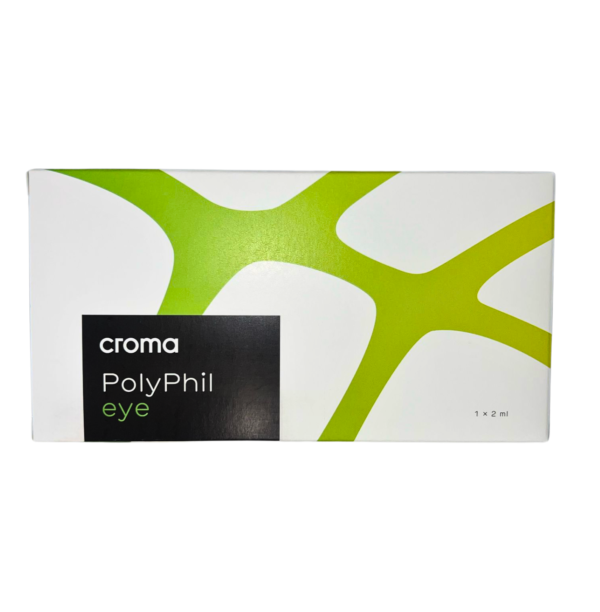
Croma PolyPhil Eye 1x2ml Polynucleotide Injectable
Original price was: $138.00.$120.00Current price is: $120.00.
Key Features and Potential Benefits Of Croma PhilArt
- Formulated with PN-HPT® (Polynucleotides Highly Purified Technology) for optimal biocompatibility.
- Supports natural cellular repair and fibroblast stimulation in delicate tissue.
- Promotes the skin’s native production of collagen and elastin.
- Enhances deep hydration and improves overall skin elasticity.
- Helps reduce the visible appearance of fine lines, wrinkles, and dark circles.
- Designed specifically for the sensitive periocular region to minimize the risk of edema.
Product Specifications
- Brand/Manufacturer: Croma Pharma
- Product Type: Polynucleotide-based injectable biostimulator
- Active Ingredient: Polynucleotides (PN-HPT®)
- Concentration: 15 mg/2 ml
- Package Contents: 1 x 2ml pre-filled syringe
- Intended Professional Application: Rejuvenation of the periocular area and other delicate facial regions.
- Regulatory Status: CE-marked for professional use. (Note: This specific polynucleotide formulation is not FDA-approved; practitioners must verify local regulatory compliance before use).
Intended Professional Use
This product is intended for use by qualified medical professionals to improve skin quality, texture, and elasticity in the under-eye and periocular areas. It is categorized as a skin-quality support treatment, making it suitable for patients presenting with skin thinness, crepey texture, or early signs of aging, rather than those requiring structural volume replacement or contouring. Administration should always be performed by a licensed practitioner who can properly assess patient candidacy, medical history, and aesthetic goals.
Why Purchase This Product?
Croma PolyPhil Eye offers a reliable, scientifically formulated solution for clinics seeking to expand their periocular rejuvenation offerings with a targeted biostimulator. Its specialized low-concentration formulation balances efficacy with safety for sensitive areas, providing a valuable addition to a professional aesthetic practice. Aesthetic Filler Store supplies verified, CE-marked professional products to support your clinic’s commitment to high-quality patient care.
For use by appropriately licensed and trained professionals in accordance with applicable federal and state requirements. Refer to the official product labeling and instructions for use (IFU) before administration. This product is not intended to diagnose, treat, cure, or prevent any disease. Individual patient responses may vary.
What Is Croma PhilArt Polynucleotide Treatment?
Croma PhilArt is a branded injectable product in the polynucleotide aesthetic-treatment category. Polynucleotides are chains of nucleotides, which are components involved in biological processes. In aesthetic medicine, products in this category are marketed for improving skin quality rather than replacing lost facial volume.
The proposed aim is to support the skin’s repair environment. Depending on the product and treatment plan, clinicians may discuss hydration, texture, elasticity, and fine-line appearance. However, a marketing description is not the same as proof that every patient will experience a particular outcome.
PhilArt should not be described as a guaranteed collagen treatment, a cure for pigmentation, or a substitute for a medical diagnosis. It also should not be confused with a standard hyaluronic-acid filler. A volumizing filler is selected when restoring shape or projection is the main goal. A polynucleotide treatment may be discussed when the goal is broader skin-quality improvement.
What Is The History And Rebranding Of Croma PhilArt?
Croma Pharma is associated with the PhilArt product line. Product names and distribution arrangements may change over time, and aesthetic products can be marketed under different names in different regions. Any claim about a rebrand, launch date, or global availability should be checked against current manufacturer documentation.
For a U.S. buyer, the practical issue is not only what the product was previously called. You also need to confirm which product is being offered, who manufactured it, where it was sourced, and whether the provider is legally permitted to administer it for the intended use.
Do not assume that a European regulatory mark means the product has FDA approval or clearance. Those are separate regulatory questions. A responsible clinic should answer questions about sourcing and labeling without pressuring you to book immediately.
What Are The Core Products In The Croma PhilArt Range?
The product family is commonly discussed through variants associated with general skin, eye-area, mature-skin, and hair-related concerns. Names and indications should be verified against the current packaging and instructions.
| Variant Discussed | Reader Concern | What To Confirm |
|---|---|---|
| Classic | General skin-quality concerns | Intended treatment areas and current label |
| Eye | Delicate area around the eyes | Whether the clinician uses it in that specific region |
| Next | More pronounced dryness or aging concerns | Ingredients, indications, and suitability |
| Hair | Scalp or hair-related concerns | Evidence, intended use, and medical alternatives |
This table is a conversation guide, not a treatment recommendation. The right choice depends on your anatomy, skin condition, medical history, previous procedures, and goal. A clinician may also decide that another treatment is more appropriate.
A useful question is: “What specific problem is this product expected to address, and what result would make us stop or change the plan?” That question encourages measurable, realistic planning without promising a fixed outcome.
How Does Croma PhilArt Eye Target Delicate Areas?
The Eye variant is marketed for concerns involving the skin around the eyes. This area is thin, mobile, and close to important blood vessels and structures. Treatment therefore requires anatomical knowledge and careful patient selection.
Dark circles do not have one universal cause. They may relate to pigmentation, visible vessels, shadowing from anatomy, tear-trough structure, thin skin, allergies, or lack of sleep. An injectable skin-quality treatment cannot be expected to correct every cause.
Ask the clinician whether your concern is primarily texture, pigmentation, hollowness, puffiness, or shadowing. If the main issue is structural hollowing, a different approach may be discussed. If it is pigmentation, sun protection and pigment-focused care may be more relevant.
Bruising, swelling, tenderness, and small raised injection points can occur around the eyes. Anyone considering treatment should understand the possibility of temporary worsening before improvement. Severe pain, skin discoloration, vision changes, or rapidly increasing swelling requires urgent medical assessment.
Why Choose Croma PhilArt Next For Mature Skin?
The Next variant is generally presented as an option for more established signs of skin aging or dehydration. The exact composition and intended use must be confirmed from current product literature rather than assumed from online descriptions.
A mature-skin consultation should assess more than wrinkles. Clinicians may consider skin thickness, laxity, sun damage, volume loss, facial movement, medications, and previous filler or energy-based treatments. A product designed to improve skin quality may not lift lax tissue or restore substantial lost volume.
Hypothetical Use Case: Dehydrated Facial Skin
A hypothetical patient notices crepey cheeks and dryness but does not want additional facial fullness. During consultation, the clinician explains that a skin-quality injectable may address only part of the concern. The patient receives a written plan that compares PhilArt with topical care, resurfacing, and filler, including downtime and cost for each option.
The sensible next step is not automatically choosing Next. It is deciding whether the expected type of improvement matches the patient’s actual goal.
How Does Croma PhilArt Hair Revitalize Scalp Health?
The Hair variant is marketed for scalp or hair-related concerns, but thinning hair has many possible causes. These include hereditary pattern hair loss, hormonal changes, nutritional deficiency, inflammatory scalp conditions, medication effects, and temporary shedding after illness or stress.
A cosmetic injectable should not replace a medical evaluation when hair loss is sudden, patchy, painful, inflamed, or associated with other symptoms. A dermatologist may recommend examination, laboratory testing, or established hair-loss treatments based on the suspected cause.
Evidence for polynucleotide products in hair-related applications should be assessed separately from evidence for skin rejuvenation. A product’s popularity does not establish that it will increase hair density for every patient. Ask for product-specific evidence, the intended endpoint, the expected time before assessment, and the plan if shedding continues.
What Is The Science Behind Croma PhilArt Polynucleotides?
Polynucleotides are biological polymers made from nucleotide units. Research into injectable polynucleotide products has proposed effects involving hydration, tissue repair, and cellular signaling. These proposed mechanisms do not prove a uniform cosmetic result.
The term “biostimulator” can also cause confusion. It does not mean that a product will produce the same effect as every collagen-stimulating injectable. Formulation, concentration, manufacturing process, injection technique, treatment area, and patient biology all matter.
A careful article should distinguish three levels of information:
| Evidence Level | What It Can Tell You | What It Cannot Prove |
|---|---|---|
| Biological theory | How the ingredients may interact with tissue | A guaranteed cosmetic result |
| Product studies | Outcomes reported for that product and protocol | That results apply to every patient |
| Independent research | Evidence across settings or products | That another brand has identical effects |
Ask the provider which statements come from the manufacturer and which come from independent research. That distinction is especially useful when a clinic uses words such as “regeneration,” “rejuvenation,” or “natural repair.”
What Do Real Patients Say About Croma PhilArt Results?
Patient experiences can help explain what treatment feels like, but testimonials are not a substitute for controlled evidence. Photographs may also be affected by lighting, camera angle, facial expression, makeup, and other treatments.
Reported expectations for skin-quality injectables often include gradual changes in hydration, texture, or fine-line visibility. Some patients may notice little change. Others may value a subtle result because they do not want added volume. Neither response establishes that the treatment is suitable for everyone.
Be cautious with testimonials that promise dramatic lifting, permanent results, or correction of several unrelated concerns. A trustworthy provider should show consistent, consented images, explain the time between photographs, and disclose whether other treatments were performed.
Which Areas Can Be Treated With Croma PhilArt?
Clinics may discuss the face, neck, décolletage, hands, eye area, or scalp depending on the product and local practice. The fact that an area is mentioned in marketing material does not mean it is appropriate for every patient.
| Area | Main Consultation Question | Important Limitation |
|---|---|---|
| Face | Is the goal texture, hydration, lines, or volume? | One product may not address all four |
| Eye area | What causes the darkness, hollowing, or lines? | The region has specialized risks |
| Neck or chest | Is the skin condition stable? | Thin skin may bruise or react |
| Hands | Is the concern texture or volume loss? | A different filler may be considered |
| Scalp | What is causing the hair change? | Medical assessment may be needed |
Treatment technique should be determined by a qualified clinician. This article does not provide injection maps, needle depth, dilution, dose, or administration instructions.
What Is The Standard Treatment Protocol For Croma PhilArt?
There is no single schedule that should be treated as universal. A provider may recommend a course of appointments followed by review, but the number and spacing depend on the product, treatment area, patient response, and local instructions.
A responsible consultation usually follows this process:
- Discuss the concern and define a realistic treatment goal.
- Review allergies, medications, pregnancy status, previous procedures, and skin conditions.
- Confirm the exact product, packaging, source, and intended treatment area.
- Explain benefits, limitations, alternatives, risks, downtime, and cost.
- Agree on a review point before deciding whether further treatment is appropriate.
Do not book a recurring maintenance plan before seeing how your skin responds. Maintenance may be discussed, but it should not be presented as mandatory or guaranteed.
Schedule a personalized consultation with a qualified medical provider if you want to assess whether Croma PhilArt is appropriate for your goals. A consultation should support informed choice, not create pressure to purchase.
What Are The Reconstitution Guidelines For Croma PhilArt?
Preparation, reconstitution, storage, dosage, injection depth, and sterility are clinical and product-specific matters. They should be taken from the current manufacturer instructions and followed by trained medical professionals.
Patients should not attempt to prepare, purchase, dilute, or inject the product themselves. Ask the clinic how it verifies the batch, expiration date, storage history, and product integrity. You may also ask whether the product is opened in your presence and whether the clinic records the product details in your treatment notes.
If a provider cannot explain how the product was sourced or refuses to identify the product being used, consider postponing treatment until the issue is resolved.
Are There Any Side Effects Of Croma PhilArt Injections?
Temporary redness, tenderness, swelling, bruising, itching, and small bumps can occur after injections. Their duration varies by person and treatment area. Follow the provider’s aftercare instructions and contact the clinic if symptoms are worsening rather than settling.
| Symptom | Possible Meaning | Appropriate Action |
|---|---|---|
| Mild redness or tenderness | Common injection reaction | Follow aftercare guidance |
| Bruising or small bumps | Local needle or product response | Monitor and contact provider if persistent |
| Increasing warmth, pus, or fever | Possible infection | Seek prompt medical advice |
| Severe pain or skin discoloration | Potential urgent complication | Seek urgent medical assessment |
| Vision change or unusual eye symptoms | Possible emergency | Obtain immediate medical care |
No injectable treatment should be described as risk-free. Risk depends on the product, area, injector, technique, patient health, and aftercare. The FDA offers general information about dermal fillers and injection-related risks in its consumer filler information.
Who Should Avoid Croma PhilArt Due To Contraindications?
A clinician should decide whether treatment is appropriate after reviewing your history. Treatment may be postponed or avoided when there is an active infection, open wound, uncontrolled inflammatory skin condition, known product allergy, or another medical concern affecting injection safety.
Tell the provider about blood-thinning medicines, bleeding problems, immune conditions, allergies, pregnancy or breastfeeding, recent procedures, and previous reactions to injectables. Do not stop prescribed medicine without medical advice.
| Before Treatment | Ask The Provider |
|---|---|
| Active rash, infection, or cold sore | Should treatment be delayed? |
| Previous injectable reaction | What product caused it and what happened? |
| Pregnancy or breastfeeding | Is postponement advised? |
| Blood-thinning medication | What is the safe plan? |
| Sudden hair loss | Should a dermatologist assess the cause? |
How Much Does A Croma PhilArt Treatment Cost?
There is no reliable national price that applies to every U.S. clinic. Cost may depend on the formulation, amount used, treatment area, provider qualifications, geographic location, number of appointments, consultation fees, and follow-up care.
Request a written quote that separates the product, clinician fee, taxes, follow-up, and any recommended add-ons. Ask whether the quoted amount covers one appointment or a full course. Avoid judging value by the number of injections alone. A lower price may reflect differences in sourcing, experience, setting, or aftercare.
PhilArt may not be the right choice if your primary concern is substantial volume loss, severe laxity, active skin disease, or unexplained hair loss. Choosing a different treatment is not a failure. It may be the more appropriate decision.
What Are The Regulatory And Storage Guidelines For Croma PhilArt?
Regulatory status depends on the product, country, intended use, and claims made by the seller. Do not assume that a product sold in one country has the same authorization in the United States. Ask the clinic to identify the legal supplier and explain the product’s current labeling.
Storage and handling must follow the current manufacturer instructions. Patients should not rely on a generic refrigeration range copied from another website. Temperature excursions, expired products, damaged packaging, or unclear sourcing should be treated as warning signs.
The FDA’s medical product safety information can help consumers understand why product status and authorized use matter. For clinical decisions, rely on a licensed medical professional who can review your circumstances.
Frequently Asked Questions About Croma PhilArt
Where Can I Purchase Authentic Croma PhilArt Products Safely?
Do not buy injectable products from unverified marketplaces or attempt self-injection. Ask a licensed medical provider about authorized sourcing, sealed packaging, expiration, batch details, and the current product instructions. Availability and legal status may vary in the United States.
How Long Does A Single Croma PhilArt Treatment Usually Last?
Duration cannot be guaranteed. Any visible change may be affected by swelling, skin condition, treatment area, technique, and other treatments. Ask the provider when results should be reviewed and what evidence supports the proposed maintenance interval.
Related products
-
Skin Booster
Rejuran S (1x1ml) *Rejuvenation with PN – Derma Fillers
Original price was: $121.00.$115.00Current price is: $115.00. Add to cart -
Skin Booster
Rescoderm Human Exosome Skin Booster Dual Vial Set
Original price was: $125.00.$115.00Current price is: $115.00. Add to cart -
Skin Booster
MESOHEAL® Pink Glow Skin Booster 10x5ml Vials Case
Original price was: $345.00.$200.00Current price is: $200.00. Add to cart -
Skin Booster
Buy MESOHEAL® Amber Glow 10x5ml Vials | Pro Supply
Original price was: $220.00.$165.00Current price is: $165.00. Add to cart
Reviews
There are no reviews yet.