
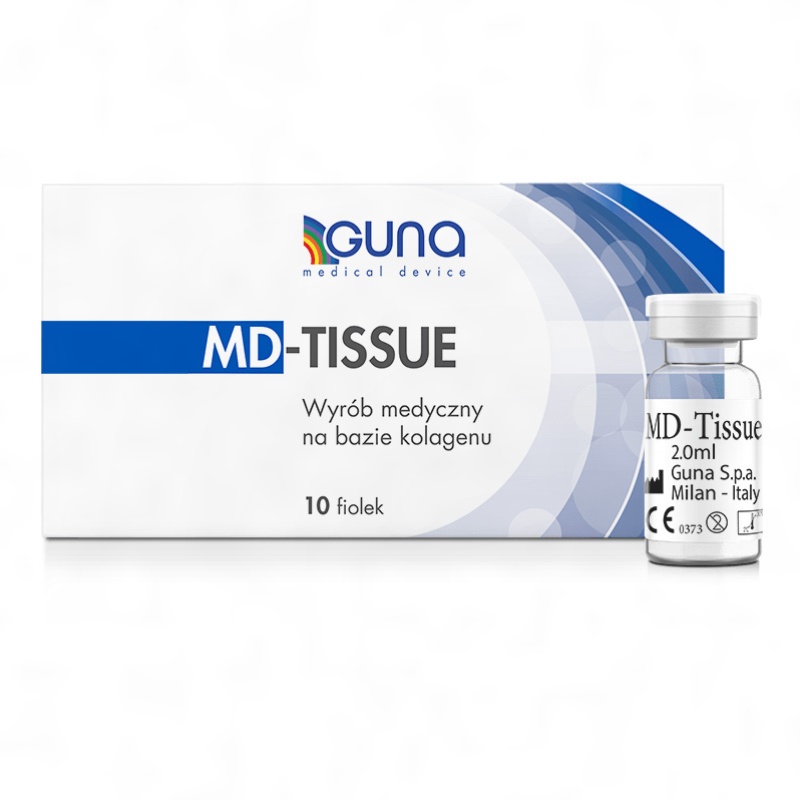

Guna MD-Tissue vials (10x2ml) – Derma Fillers
Original price was: $130.00.$100.00Current price is: $100.00.
Guna MD-Tissue is a collagen-based injectable medical device designed to counteract physiological aging of the connective tissue.
What Is Guna MD-Tissue And How Does It Work?
Guna MD-Tissue is an injectable collagen-based medical device made by GUNA S.p.a. in Milan, Italy, and supplied in sterile single-use vials for administration by clinicians. In Europe it sits in the highest medical device risk class under EU rules, which is a CE-marking category and not an FDA designation.
The proposed mechanism is mechanical rather than pharmacological. Injected collagen is intended to act as a temporary supporting matrix within connective tissue, providing structure while the body’s own repair processes work. Published support for that mechanism comes mainly from small clinical series and manufacturer literature, so treat the effect as plausible but not firmly established.
How Much Does Guna MD-Tissue Cost In Different Markets?
There is no reliable published US price, and I will not invent one. Any figure you see quoted in dollars comes from a foreign distributor or reseller, and it excludes the two costs that matter most: the clinician’s time across an entire multi-session course, and the legal risk of importing a device that lacks US marketing authorization. The FDA’s personal importation rules explain the narrow circumstances in which unapproved products may enter the country, and cosmetic convenience is not one of them.
Instead of chasing a number, price the variables below and ask any clinic to itemize them in writing.
| Cost driver | What it changes | What to ask the clinic |
|---|---|---|
| Number of sessions | Total spend, often the largest factor | Is the quote per session or per full course? |
| Vials used per session | Product cost | How many 2 mL vials for my treatment area? |
| Clinician type | Fee per visit | Who injects, and what is their license? |
| Sourcing route | Legal and product-integrity risk | Where was this stock purchased, and can I see the insert? |
How Do GUNA Products Compare To Other Regenerative Brands?
The honest comparison is not against other regenerative brands but against what you can legally and predictably obtain in the United States. Collagen-based devices aim to support structure; hyaluronic acid fillers add volume; both differ from autologous preparations made from your own blood. The FDA’s overview of soft tissue fillers sets out which categories carry US approval and their known risks.
| Factor | Collagen device (MD-Tissue type) | FDA-approved HA filler |
|---|---|---|
| US marketing status | No approval or clearance evident | Approved for specified uses |
| Primary aim | Structural support, gradual change | Immediate volume correction |
| Reversibility | Not reversible; resorbs over time | Often reversible with hyaluronidase |
| Evidence base | Small studies, manufacturer data | Registration trials, post-market data |
If you want a regenerative approach, ask a board-certified dermatologist or plastic surgeon which US-authorized options address your specific concern before importing anything.
How Does The Price Of Guna MD-Tissue Reflect Its Clinical Quality?
Price reflects manufacturing standards, distribution, and clinician time. It does not reflect proven superiority. A higher figure tells you nothing about outcomes, and sellers who imply otherwise may be crossing the line described in FTC health claims guidance, which requires competent and reliable scientific evidence behind efficacy claims. Judge value by the quality of the consultation, the documentation you are shown, and the realism of the outcome discussion.
How Does Guna MD-Tissue Counteract Connective Tissue Aging?
Collagen is the dominant structural protein in the dermis, and its network becomes thinner and more disorganized with age and sun exposure. Reduced structural collagen contributes to laxity, fine lines, and reduced resilience.
The device’s stated purpose is to place a biocompatible collagen matrix into that weakened tissue so it can serve as temporary scaffolding while resident cells remodel the area. Independent evidence for durable remodeling in humans remains limited, so expect gradual, modest change rather than a filler-style correction, and expect results to fade without maintenance.
What Role Does Swine Or Horse Derived Collagen Play In Guna MD-Tissue?
The collagen base is animal-derived, and manufacturer documentation specifies the species for each product; verify it on the insert before treatment rather than relying on any website. Animal type I collagen closely resembles human collagen, which is why it has long been used in medical materials.
Purification is designed to reduce immunogenic components, but hypersensitivity remains possible. Anyone with a history of collagen, porcine, or equine product reactions should discuss testing with their clinician and should not proceed on assurance alone.
How Do Vitamins And Minerals Enhance The Guna MD-Tissue Formula?
The formulation includes small quantities of ascorbic acid, thiamine, riboflavin, pyridoxine, and magnesium gluconate alongside collagen. Vitamin C has a genuinely established role here: it acts as a cofactor for the enzymes that hydroxylate proline and lysine during collagen synthesis, as summarized in the NIH vitamin C fact sheet.
What is not established is that these micro-quantities, delivered locally, measurably improve outcomes over collagen alone. Treat them as supportive components, not as the reason to choose the product, and ask for the exact concentrations if a seller markets them as a differentiator.
What Are The Primary Applications Of Guna MD-Tissue In Aesthetic Medicine?
In markets where it is authorized, it is used for localized biostimulation of the face, neck, décolletage, and hands, targeting fine lines, crepey texture, and mild laxity rather than deep folds or volume loss. It is not a substitute for surgery, energy-based tightening, or approved fillers.
Use case: A 47-year-old with thinning skin on the neck wants gradual softening without added volume. She is told a course would run several weeks with modest, cumulative change. Her clinician also discloses the product’s US status. She decides to compare an FDA-authorized biostimulatory option first, then revisit the decision with full pricing for both paths. The likely limitation either way is that neck laxity responds slowly, and neither route removes loose skin.
How Does Guna MD-Tissue Support Regenerative And Orthopedic Recovery?
In European practice, collagen devices in this family are also injected around joints, tendons and ligaments with the stated aim of providing mechanical support to strained tissue. Reported benefits center on comfort and function during rehabilitation. Evidence quality here is weaker than in aesthetics, and results should not be presented as accelerated healing.
Use case: A recreational runner with persistent lateral elbow pain asks about collagen injections after physical therapy plateaus. A responsible clinician first confirms the diagnosis by examination and imaging, reviews approved options, explains that evidence is limited, and continues loading exercises regardless of what is injected. Skipping the diagnostic step is the common and costly mistake.
In What Ways Does Guna MD-Tissue Protect Joint Capsules And Tendons?
The proposed action is local mechanical support and reduced friction at irritated periarticular structures, which may ease movement-related discomfort. This is a supportive role, not repair of a structural tear.
Injections must never be placed into an actively infected joint, and anyone on anticoagulants, with uncontrolled diabetes, or with suspected tendon rupture needs medical clearance first. Sudden worsening pain, swelling, fever, or redness after any injection warrants urgent care.
Can Guna MD-Tissue Be Used Alongside Other Orthopedic Therapies?
It is generally described as compatible with physical therapy and other conservative care, and rehabilitation remains the component with the strongest evidence behind it. Progressive loading, not the injection, is what typically restores tendon capacity.
Tell every clinician involved what has been injected, when, and by whom. Combining injections from different providers without a shared record is how patients end up over-treated and under-diagnosed.
What Is The Standard Administration Protocol For Guna MD-Tissue?
Manufacturer guidance describes an initial intensive phase followed by weekly maintenance, delivered by a trained clinician using micro-injections across the treatment area. Dosing, depth and needle choice are clinical decisions made per patient, so this article deliberately does not publish injection technique.
| Phase | Typical frequency | Purpose |
|---|---|---|
| Initial | Two sessions weekly for two weeks | Establish treatment response |
| Consolidation | One session weekly | Continue cumulative effect |
| Full course | About 8 to 10 sessions total | Assess outcome before repeating |
| Maintenance | Periodic, as advised | Sustain any achieved change |
Each vial contains 2 mL and is intended for single use. Any opened vial should be discarded after the session.
What Are The Exact Specifications Of Guna MD-Tissue 10 Vials?
Standard packaging is ten sterile 2 mL vials per box, with storage conditions printed on the package insert; follow that document rather than any figure quoted online. Pack contents and labeling can differ between markets, which is exactly why the physical insert matters more than a product page.
Before money changes hands, work through this checklist with your provider.
| Check | Why it matters |
|---|---|
| Lot number and expiry visible | Confirms traceability and shelf life |
| Insert present and legible | Verifies composition and storage |
| Intact seals, no damage | Sterility depends on packaging integrity |
| Provider license and insurance | Determines your recourse if harmed |
How Many Sessions Are Typically Required For Optimal Guna MD-Tissue Results?
Manufacturer guidance points to roughly 8 to 10 sessions, with any early change usually noticed part-way through the course. Individual response varies with age, skin condition, and the extent of tissue change. Because the schedule is not validated by large trials, agree in advance on how success will be judged and when you will stop.
How Does The Guna MD-Tissue Kolagen 10 X 2 mL Packaging Ensure Sterility?
Sterility is produced at manufacture through controlled aseptic processing and maintained by sealed single-use vials. It is not guaranteed afterward: temperature excursions, damaged packaging, and grey-market handling all compromise it, and counterfeit stock is a real risk with imported aesthetic products.
Once a stopper is pierced, the sterile barrier is broken. Sharing a vial across patients or sessions is unacceptable practice.
Why Are Guna MD-Tissue Collagen Medical Devices Supplied In Injectable Vials?
Vials let a clinician draw only what a given area requires and select an appropriate needle, which matters when treatment zones differ in depth and sensitivity. That flexibility is a clinical advantage, not a consumer feature.
The same format makes home use dangerous, because nothing about a vial prevents contamination, incorrect placement, or vascular injury.
What Is The Difference Between The 10 Vial And 5 Injectable Vial Packs Of Guna MD-Tissue?
The ten-vial box is presented as sufficient for a full treatment course, while smaller packs, where a distributor offers them, suit maintenance or limited areas. Availability of a five-vial presentation varies by market and cannot be assumed.
Buy according to the plan your clinician documents, not according to a bulk discount. Excess vials sitting in a cupboard invite expired product and improvised treatment.
Which Guna MD-Tissue Decision Path Fits Your Situation?
This quiz is educational and is not medical advice or a diagnosis.
Question 1: Are you in the United States and being offered this product?
If yes, go to Question 2. If you are being treated in a country where the device is authorized, go to Question 3.
Question 2: Has the clinic shown you the package insert and explained the product’s US regulatory status in writing?
If no, stop and request it before paying; an unwilling seller answers your question by refusing. If yes, go to Question 3.
Question 3: Is your goal cosmetic or musculoskeletal?
If cosmetic, review the comparison table above and price an FDA-authorized alternative alongside it. If musculoskeletal, go to Question 4.
Question 4: Has a clinician examined you and confirmed a diagnosis?
If no, get the diagnosis first; injections without one waste money. If yes, ask what evidence supports this device for your specific condition and what the rehabilitation plan is either way.
Frequently Asked Questions About Guna MD-Tissue
How Many Guna MD-Tissue Sessions Are Needed For Visible Results?
Manufacturer protocols describe about 8 to 10 sessions, with any noticeable change appearing partway through rather than immediately. Because supporting studies are small, treat that range as a planning estimate. Agree with your clinician on a review point, and be prepared to stop if nothing measurable has changed.
Where Can I Find Certified Providers For Guna MD-Tissue Treatments?
There is no US certification for this device, because it is not authorized for US marketing. Look instead for a licensed physician, physician assistant or nurse practitioner working within their scope, and verify the license through your state board. Ask three questions: where the product was sourced, what the insert says, and who manages complications. If a clinic cannot answer all three clearly, book a consultation elsewhere.
Related products
-
Skin Booster
Restylane Skinboosters Vital Light Lidocaine 1x1ml
Original price was: $100.00.$90.00Current price is: $90.00. Add to cart -
Skin Booster
Buy Plinest Eye 1x2ml Polynucleotide Gel for MDs
Original price was: $105.00.$100.00Current price is: $100.00. Add to cart -
Skin Booster
Mesoheal Orchid Glow 10x5ml Aesthetic Skin Booster
Original price was: $250.00.$170.00Current price is: $170.00. Add to cart -
Skin Booster
Karisma Rh Collagen Softfiller Face 2ml Pro Device
Original price was: $160.00.$108.00Current price is: $108.00. Add to cart


Reviews
There are no reviews yet.