
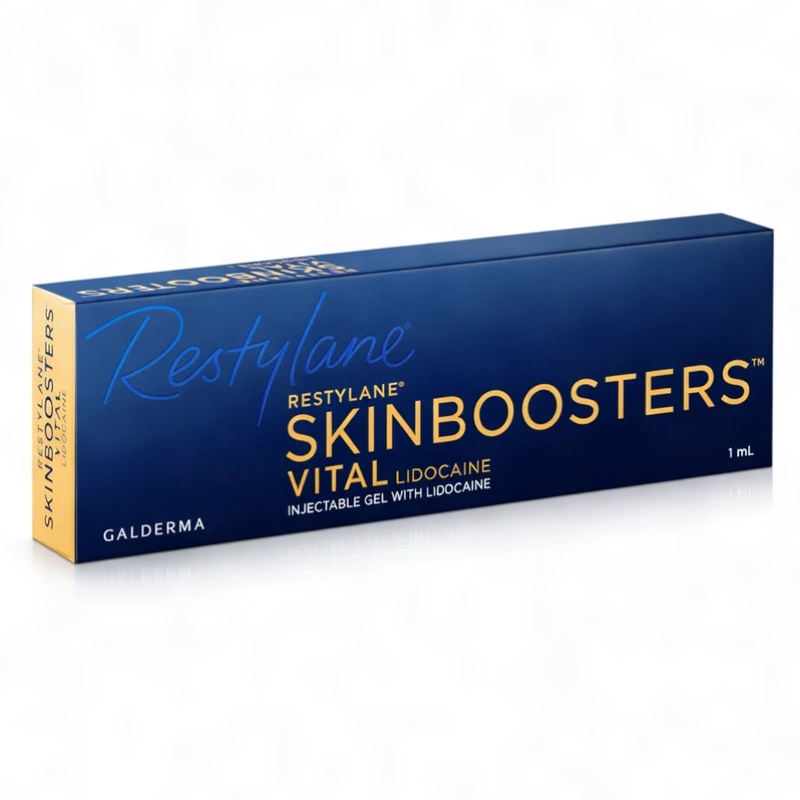
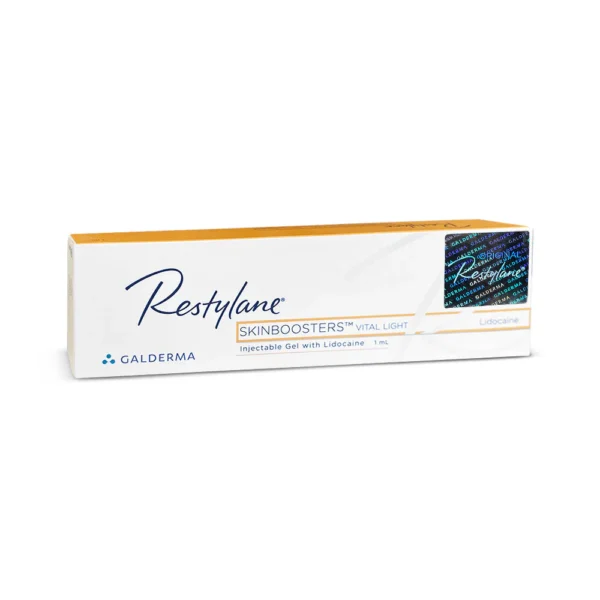
Restylane Skinboosters Vital Light Lidocaine 1x1ml
Original price was: $100.00.$90.00Current price is: $90.00.
Restylane Skinboosters Vital Light Lidocaine 1x1ml is a hyaluronic acid gel developed by Galderma. Formulated with 12 mg/ml of stabilized hyaluronic acid and 3 mg/ml (0.3%) lidocaine, this product aims to enhance skin elasticity, smoothness, and radiance without adding significant volume. Each package contains one 1ml pre-filled syringe and three sterile 30G 1/2″ needles.
- This product uses NASHA™ technology to provide stable, long-lasting hydration within the skin.
- It is formulated with smaller particle sizes that are optimised for superficial placement.
- It helps to restore moisture levels, improving overall skin texture and smoothness
- It is designed to enhance natural radiance and skin elasticity in delicate areas
- It contains integrated lidocaine (0.3%) to help minimise discomfort during treatment.
- The pre-filled syringe features the SmartClick™ delivery system, which assists practitioners in administering precise, controlled micro-doses.
Product Details
Intended professional application: Superficial dermal micro-injections for improving skin quality
Restylane
Restylane is a hyaluronic acid dermal filler manufactured by Galderma and cleared by the FDA for specific facial indications. Hyaluronic acid occurs naturally in skin.
In filler form, it is cross-linked into gels of different firmness and cohesivity, then placed at defined depths to restore volume, smooth folds, or reshape features.
Different formulations exist because no single gel works well everywhere. A firm gel supports cheek projection. A softer gel gives lips natural movement.
Product selection should match anatomy, depth, and goal, and it should be made by a licensed injector after a face-to-face assessment.
How does Restylane work?
Restylane involves injecting a hyaluronic acid gel beneath the skin to add immediate volume and bind water. The gel is gradually metabolised and disappears over several months.
The depth of placement matters. Superficial deposits can soften lines. In contrast, a deep injection near the periosteum can lift a cheek. The provider chooses the depth based on the rheology of the product and the target area.
Restylane is not Botox. Botulinum toxin relaxes the muscles that cause dynamic wrinkles. Fillers add volume to address structural or static concerns. Many patients opt for a combination of the two because they address different issues.
What are the different Restylane fillers used for?
Each Restylane product is designed for specific tissues, layers and movement patterns. The table below shows the current range and its main FDA-approved uses in the United States, based on information from the manufacturer and regulatory bodies.
| Product | Primary FDA-Approved Use | Typical Character |
|---|---|---|
| Restylane / Restylane-L | Nasolabial folds, lip augmentation | Balanced, versatile |
| Restylane Lyft | Cheek augmentation, midface volume, back of hands | Firm, lifting |
| Restylane Silk | Lip augmentation, perioral lines | Soft, smooth |
| Restylane Refyne | Nasolabial folds and marionette lines with movement | Flexible |
| Restylane Defyne | Deeper folds and chin projection | Flexible but firmer |
| Restylane Kysse | Lip augmentation and lip texture | Soft, pliable |
| Restylane Contour | Cheek augmentation | Cohesive, adaptable |
| Restylane Eyelight | Under-eye hollows (tear trough) | Cohesive, low-swelling profile |
Check current product details on the FDA dermal filler page before your appointment.
What is the best filler for older skin?
There is no single best filler for older skin. The best option depends on factors such as skin quality, bone structure, volume loss pattern and goals, rather than age alone.
Mature skin often responds better to a conservative, staged approach. Overfilling can distort proportions and stretch already thin skin. Two smaller sessions often produce a better result than one large one.
Which areas can Restylane treat?
Restylane can address volume loss and contour changes across the mid-face and lower face, as well as static lines.
Contact a board-certified aesthetic provider for a personalised Restylane treatment plan.
How long does Restylane filler last?
The duration of results varies depending on the product, the area treated, the injection technique and individual metabolism, but most Restylane results last between six and 18 months. Lips typically fade faster due to constant movement. Results in the cheek and jawline areas usually last longer because these areas move less.
Although product studies submitted to the FDA generally support these timeframes, they are averages, not guarantees. A faster metabolism, regular exercise and thinner tissue can shorten the duration of the results.
What happens when Restylane wears off?
The body gradually breaks down hyaluronic acid through natural enzymatic activity. As the filler dissolves, the treated area gradually returns to its appearance before treatment over the course of weeks and months.
Your skin does not become dependent on the filler. Once the hyaluronic acid (HA) is gone, the underlying tissue is as it was before, minus any normal ageing that occurred during the same period.
If you are unhappy with the results or wish to stop the treatment, an injector can use hyaluronidase to dissolve the HA filler. While this use is off-label for cosmetic reversal in the United States, it is a widely accepted clinical practice.
How much does Restylane cost?
The price of Restylane depends on the product, the number of syringes used, the expertise of the person administering the treatment, and your geographic location. According to statistics from the American Society of Plastic Surgeons, the national average for HA fillers in 2022 was approximately $684 (£530) per syringe. This figure is a benchmark, not a quote.
Very low prices may indicate a diluted product, an inexperienced injector or an incomplete treatment plan. Ask what is included and confirm that the product is genuine, sealed and labelled.
Is Restylane better than Juvederm?
Neither brand is universally superior. They are both made from hyaluronic acid and use different cross-linking technologies: Restylane uses NASHA and XpresHA, while Juvederm uses Vycross and Hylacross. The right choice depends on the specific product and your needs.
Ask your provider which product they are planning to use in your area and why. A good answer will take into account your tissue, movement and desired outcome, rather than brand loyalty.
Is Restylane Different From Sculptra?
Yes. Restylane adds immediate volume with hyaluronic acid. Sculptra is poly-L-lactic acid, which stimulates your body to build collagen over months.
The two work on different timelines. Restylane shows results the same day and can be dissolved. Sculptra shows gradual improvement across multiple sessions and is not easily reversed. They can complement each other in a staged plan.
What are the risks and complications of Restylane?
Injectable fillers carry risks beyond routine swelling and bruising. Vascular occlusion, where filler enters a blood vessel and blocks blood flow, is rare but serious.
Call your provider or seek emergency care if you notice any of the signs in the table below.
| Warning Sign | Possible Concern |
|---|---|
| Severe or worsening pain | Vascular occlusion |
| Skin blanching or mottling | Vascular occlusion |
| Blistering or blue-gray discoloration | Vascular occlusion |
| Sudden vision changes | Retinal artery involvement (medical emergency) |
| Spreading redness with fever | Infection |
| Firm painful lumps weeks later | Nodule or biofilm |
Reduce risk by choosing a board-certified dermatologist, plastic surgeon, or oculoplastic surgeon experienced in fillers. Use the ASPS Find a Surgeon tool to verify credentials.
Who should not have Restylane treatment?
Restylane is not suitable for everyone. According to the prescribing information provided by Galderma, the treatment should generally be avoided during pregnancy or breastfeeding, in patients with severe allergies (particularly to lidocaine in Restylane-L formulations), in individuals with bleeding disorders and in cases of active skin infection at the injection site.
You should disclose all medications, supplements, autoimmune conditions, prior filler treatments and recent or planned dental work. Some medications can increase bruising, and dental work can introduce bacteria near recent filler sites.
What are the common side effects of Restylane?
These include swelling, bruising, redness, tenderness, itching and small bumps at the injection site. Most of these resolve within a few days to two weeks.
It is important to distinguish routine reactions from red flags. Swelling that peaks after 24 to 72 hours and improves steadily is normal. However, pain that worsens, pale or mottled skin, or vision changes are not normal.
What should you expect before a Restylane treatment?
You can expect a consultation that will review your medical history, examine your face in motion and at rest, and outline the choice of product, the number of syringes required, and the cost. Photos are typical.
To minimise bruising, most providers recommend the following in the week before treatment, unless advised otherwise by a prescribing physician:
Bring a list of questions. Useful questions include: Which specific Restylane product will you use? How many syringes do you recommend, and why? What are your complication protocols? Do you keep hyaluronidase on site?
What happens during a Restylane procedure?
The practitioner cleans the skin, marks the target areas and often applies a topical anaesthetic. Restylane-L formulations contain lidocaine for added comfort. Depending on the area and product, injections use a fine needle or a blunt cannula. Cannulas can reduce bruising and lower vascular risk in certain areas.
The injector may massage or mould the product, and then check the symmetry with you standing up. Appointments range from 15 minutes for a small lip touch-up to one hour for full midface treatment.
If you choose option C, please note that only Restylane Eyelight is FDA-approved for treating under-eye hollows. Make sure your injector has specific under-eye experience and discusses risks with you openly.
What should you expect after Restylane treatment?
You can expect swelling, mild bruising, tenderness and possible small bumps that will soften over the next few days. The initial appearance may be fuller than the final result due to swelling. Most patients see the final result within two weeks.
For 24 to 48 hours afterwards, most providers advise avoiding strenuous exercise, alcohol, saunas, facials and sleeping face down. Sleep with your head slightly elevated to reduce swelling.
Contact your provider promptly if you experience worsening pain, blanching, mottling, changes to your vision, spreading redness or firm, painful lumps. Consumer-facing safety information is available on the FDA Filling in Wrinkles Safely page.
Frequently Asked Questions about Restylane
What is Restylane and how does it work?
Restylane is a range of hyaluronic acid dermal fillers that have been cleared by the FDA for use in facial contouring, wrinkle correction and lip enhancement. A gel is injected beneath the skin to add volume and hydration. The results are visible immediately and gradually fade as the body breaks down the hyaluronic acid.
How long will the results of Restylane filler last?
Most Restylane results last between six and 18 months. Lip treatments typically fade faster due to constant movement. Treatments to the cheeks, chin and jawline usually last longer. The duration of results can be influenced by factors such as metabolism, technique, product choice, and volume injected.
Related products
-
Skin Booster
Mayster PDRN Skin Booster Set for Professional Use
Original price was: $244.00.$230.00Current price is: $230.00. Add to cart -
Skin Booster
Rejuran Elaskin Essence 2ml x 2 Syringes | Shop US
Original price was: $299.00.$199.00Current price is: $199.00. Add to cart -
Skin Booster
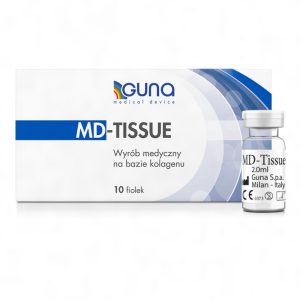
Guna MD-Tissue vials (10x2ml) – Derma Fillers
Original price was: $130.00.$100.00Current price is: $100.00. Add to cart -
Skin Booster
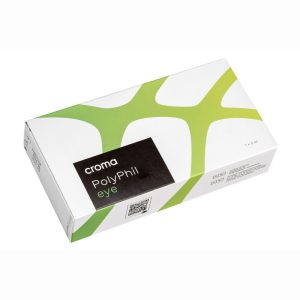
Croma PolyPhil Eye 1x2ml Polynucleotide Injectable
Original price was: $138.00.$120.00Current price is: $120.00. Add to cart
Reviews
There are no reviews yet.